

Based on current local search statistics, approximately 27% of users searching locally no longer click on any websites after conducting their query.
As a result, businesses must secure a customer's attention directly on the search engine results page rather than relying solely on organic ranking and website clicks to establish themselves as the go-to source for area customers.
To maximise local visibility, businesses must ascertain ways to capture nearby market share. This requires understanding the tools, processes and attribution models necessary for local SEO lead generation and measuring local visibility to generate revenue.
The Transition From Ranking Metrics to Actual Lead Attribution
Traditionally, local search has been largely centred around keywords and "ranking".
As their businesses grow and achieve success, brands need to begin measuring their successes and failures based on how many leads resulted from each, as opposed to the volume of overall website traffic derived through local search.

Unless businesses understand specifically where their potential customers originate from via local search or search engine visibility, they are unable to accurately determine their marketing ROI.
Defining Actual Lead Actions
The focus of a successful local search program should be on tangible outcomes. Each Google Business Profile receives an average of 81 separate actions each month.
By breaking down and analysing these actions we can begin to understand user intent. Approximately 38 per cent of this interaction is comprised of driving direction requests.
In addition, an estimated 35 per cent of this interaction leads to website visits, while about 27 per cent result in actual phone calls. Tracking the specific types of local search actions taken by potential customers allows companies to more accurately assess and anticipate customer demand. Doing so is more informative than simply checking their ranking positions within the search engines.
How AI Impacts Local SEO Lead Generation
Artificial intelligence is revolutionizing user interaction with local results. Geo-specific search features and AI Overviews have made it possible for the AI to answer many questions before a user clicks on a link.
According to data, approximately 16.7% of the pages cited by AI platforms were outside of the traditional top 10 search results. This indicates that businesses that want to be visible through AI must ensure that they are represented on multiple platforms.
Google Business Profile Conversion Strategies
Additionally, business owners should view their Google Business Profile as their most valuable asset regarding local SEO lead generation campaigns. Simply claiming their profile with basic details does not guarantee high conversion rates. Business owners must consider their Google Business Profile as a separate conversion tool.
All photos, categories, and updates must ultimately guide users to make a phone call or book a service with the business. The more photos a business uploads to their Business Profile, the more active the profile appears to local searchers.

The recommended photo cadence is to upload three to five new photos a week that represent real work, team members, and the exact services the business provides. This builds instant trust with local searchers.
Review Velocity and Customer Trust
The number of new reviews a business receives per month is a major conversion trigger. If a business receives one hundred new reviews in one month and then receives no new reviews in the following month, it raises red flags to both users and search algorithms.
The target is to maintain a consistent review rate of between 3 and 5 per week. To achieve this, companies must implement strict internal processes.
A company should ask for a review as soon as the service is done, preferably within the first two hours. A high percentage of customers will leave positive reviews if provided with SMS text prompts or direct QR codes at the time of service completion.
Geo-Grid Diagnostics and Proximity Bias
Search engines strongly favour businesses based on proximity to the user. This creates narrow 'pools' of visibility for local businesses.
Previous methods for tracking rankings did not give an accurate representation of this phenomenon. For example, a company could rank first with a user who lives one mile to the north, yet be totally off the first page with a user that lives one mile south.
Using Grid Scans for Local Visibility
Advanced local search teams use a method called 21x21 geo-grid tracking to understand the actual market area in which a business operates. This 21x21 grid allows for visual identification of where a business appears in local search results throughout a city. It helps determine what geographic area is covered with that visibility.
The results can sometimes be surprising. For example, I analysed the visibility for 319 heating and air contractors in Denver, and found that 96.2% of them had less than 20% visibility across the entirety of their metro area.
By using the grid scan process, a business can quickly determine whether their visibility issues are due to their visibility or a conversion issue. This reveals what changes need to take place.
If they have high visibility but few leads, they need to work on improving their profile's conversion elements.
Creating Location-Based Service Pages
If a business wants to expand beyond their immediate geographic area, they need to create specific location service pages on their website.
Each of the service areas must consist of specific details on the services, with proper local schema markup.
The local schema markup provides the search engines with the company's coordinates, the area's and types of service provided, and company specifics in a structured format.
Top Software Providers for Local SEO Lead Generation
There are different software providers to help clients manage local search. To scale local visibility on a multitude of locations, companies must look for specific software. The choice of platform will depend on whether your company requires bulk listing management, citation clean-up, or grid diagnostics.
BrightLocal and Semrush Local
BrightLocal is an excellent solution for both agencies and small business owners wanting to identify detailed reporting and tracking. Their subscription pricing starts at $31-$41 per month for annual subscription plans, making it affordable to most standard local SEO activities.

Semrush Local serves as a powerful supplemental service to those already using the Semrush platform. The Semrush platform now provides visibility to seven different engines for the AI, priced around $30-$60 monthly by location.
Local Falcon and Whitespark
Local Falcon is one of the most recognized companies in providing 21x21 geo-grid rank tracking services. They operate on a credit-based pricing model, starting at $24.99 per month, making them an ideal option for those who want to focus on precise geographical placements on maps.
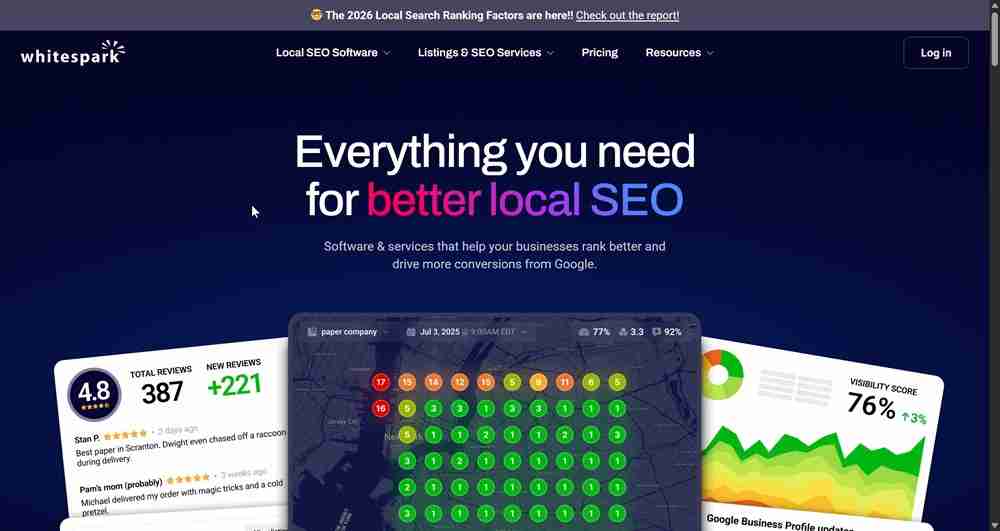
Whitespark offers excellent citation building and reputation management tools. Their rank tracker is priced at approximately $14 per month, while the reputation management tools start at approximately $79 per month, making it an excellent choice for citation-based programs.
Enterprise Multi-Location Platforms
When it comes to enterprise-level franchise brands that have hundreds of locations, the only option available to them is Yext. This platform offers enterprise-grade listing management and knowledge graph control through customized quotes.
Synup provides a subscription service for agencies and businesses with multiple locations with plans beginning at $39 dollars a month. All plan subscribers have access to fully-featured plans.
Birdeye specializes in handling reviews on an enterprise scale and charges a monthly rate of $299-$449 per location to do so. Uberall provides extensive synchronization between different locations on one platform for enterprise-level businesses.

Assessing Agency Value and Campaign Costs
Assessing the value of outside marketing companies for local search engine optimization (SEO) is more than just examining the tasks performed. It should also include reviewing the estimated volume of leads generated as a result of the services being provided and verifying that the costs will be openly available.
Most marketing companies still don't disclose their prices. However, the price range of what a local SEO company typically charges for local SEO lead generation is between $500-$5000 per month based on market competition and the number of locations serviced.
Real Case Studies and Generated Leads
The value placed on local search execution as a marketable service has been demonstrated through reliable data. Titan Web Agency published the results of one such reliable effort through local search for a dental practice that yielded 2,943 patient leads (tracked) in one year alone.
Of these leads, 77% came directly from the Google Business Profile.
As an additional example, Eric Scott Studios conducted a local marketing campaign that produced 4,055 potential lead actions for an engineering contractor, resulting in 1,010 phone calls, 665 website clicks and 2,380 requests for directions.
Additionally, in one pest control campaign, a significant reduction of over 75% in cost per lead occurred in a single month that yielded 169 new leads, resulting in the pest control company hiring 5 new technicians.
Retainer Scopes that Reflect Business Needs
Pricing structures for local SEO services should accurately reflect the target market volume generated through the services being provided. The typical pricing for a basic local SEO package is between $500 and $900 per month.
Typically, the entry-level tiers are for only one location, include basic profile updates and provide standard citation management.
The growth tier offers $900-$2500/month plans that generally include up to three locations, active review management, and monthly content creation support.
The aggressive plans start at $2500/month and reach/ exceed $5000/month. These plans typically include support for four or more locations and significant amounts of link-building activity.

Agencies such as KOinbound have created transparency in the pricing schedule for local search management, stating a fee of $750/month (no setup fees). This has led to local search agencies clarifying the specific deliverables they are providing in the marketplace.
Advanced Attribution for Local SEO Lead Generation
If a business cannot determine where a phone call originated from, they are essentially in the dark. The proper attribution of phone calls requires integrating local search details with the company's internal sales platform.
If a company cannot trace a phone call back to a search effort, there is no way for marketing teams to quantify the monetary value of their company's map pack rankings.
Tracking Phone Calls and Clicks
Setting up specific tracking numbers dedicated to local search profiles is essential when tracking calls for attribution. By using these unique phone numbers, businesses may distinguish between calls generated from an actual local search, versus those calls to the business coming from a general visit to their website.
Additionally, businesses must append UTM tracking codes to their Google Business Profile link to gather accurate phone call data.
The UTM codes demonstrate to Google Analytics how many visitors landed on the business's website directly from the map listing as opposed to the standard organic search results.
Data Aggregator Delays
Creating consistent business data across the web is not a one-step process. Companies need to submit their Name, Address and Phone number (NAP) to the leading data aggregators.
Operational delays – commonly referred to as "processing delays" – usually occur anywhere between two and four months after starting a campaign. During this timeframe, duplicates of listings may appear and/or the updates from data aggregators may lag considerably due to changes made in "real time."
Tracking these processing delays requires that businesses maintain a consistent audit on their listings. Company representatives must manually check their major listings to confirm that any old or incorrect addresses and/or phone numbers are deleted completely before they will attain true data consistency.
Local SEO Lead Generation Strategies for Consistent Revenue
Generating consistent revenue from local search engine optimization requires businesses to build an entire infrastructure around their search engine optimization strategy. This includes lead conversion and attribution along with the profile set-up process.
By leveraging the 21x21 geo-grid, businesses can identify where they actually appear in Google searches, by using strict photo and review cadences to convert visitors before they even click through their website links.
By using accurate call tracking tools and UTM model attribution, a company's marketing department can directly connect a company's local search visibility and local SEO lead generation efforts to inbound phone calls and measured revenue growth.
Executive Overview of Local Search Operations
Why do review generation systems stop working after the second month?
Most businesses depend on manually requesting reviews via text and/or email. Once businesses have completed their initial push to their previous clients, the remaining reviews that are produced as a result of the manual process (i.e., by prompting an email) begins to decline rapidly. To keep the velocity of 3-5 reviews per week going, businesses must automate this process using either SMS text messaging prompts to be sent to clients or QR codes at the front desk that get sent within two hours of receiving any appointments.
How do AI overviews change the local mapping process?
AI overview systems change the way search results are displayed by providing frequent responses to users without clicking on anything. As a result, because AI reports frequently refer to pages outside of the standard top 10, businesses must focus on consistency across multiple platforms. The goal is for businesses to be heavily cited on all major platforms by industry authority figures, rather than solely ranking a single domain.
What is the primary reason for a loss of geo-map pack visibility?
The most common reason for businesses losing local geo map pack visibility and failing at local SEO lead generation is due to inconsistent data profiles across the entire internet. When all major data aggregators find discrepancies, or differences, in a company's NAP (Name, Address, Phone) listing, search engines cease providing trust for that entity's physical location. As a result, the entities' geo-mapped service areas decrease dramatically.